
Archipelago at SAFET 2026: computer vision you control
At SAFET 2026 in Cebu, Robin Prussin argued that electronic monitoring programs should own their detection models. FishVue AI is built to make that practical, and we share what we heard from others working on implementation.
September 20, 2026
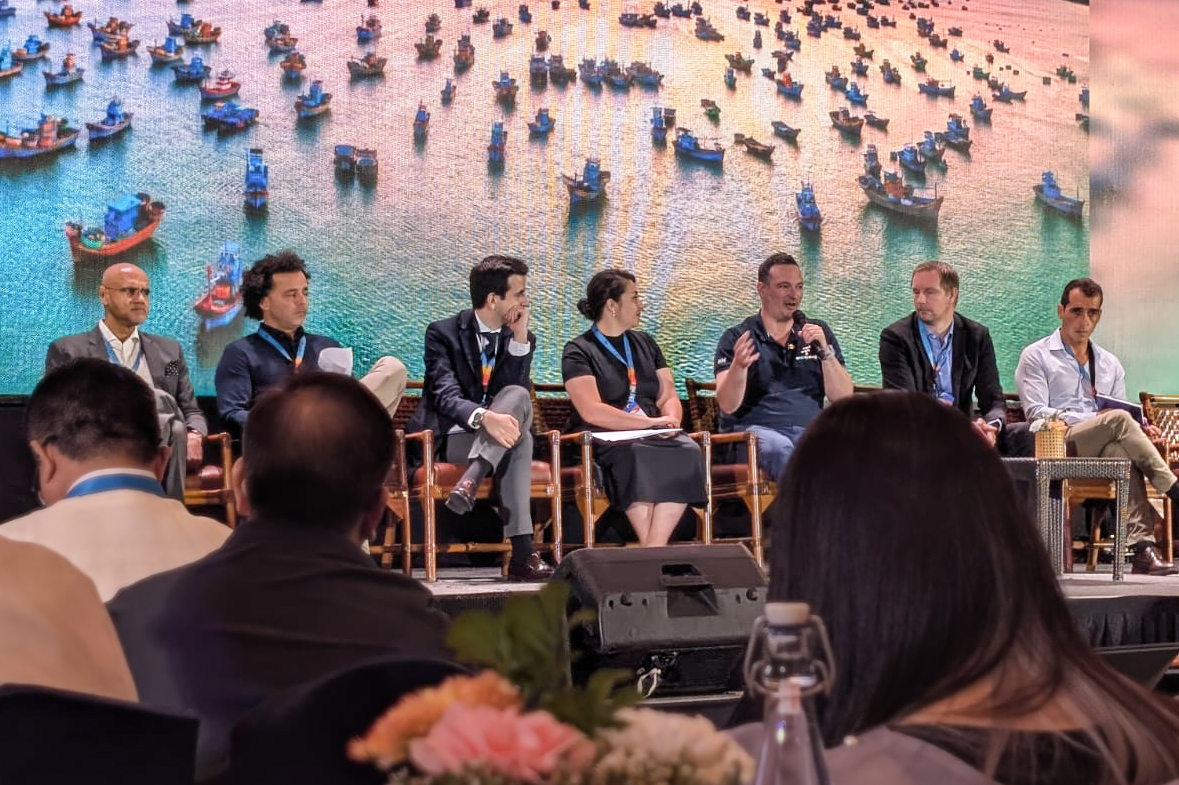
Robin Prussin and Dr. Erin Kydd attended SAFET 2026 in Cebu from 8 to 10 September, where Robin spoke on the opening morning panel on the latest developments in electronic monitoring. SAFET is co-hosted by the Philippine Bureau of Fisheries and Aquatic Resources and the British Embassy Manila, and this year drew more than 400 fisheries authorities, technology developers, researchers, development organizations and small scale fishing representatives. The theme was From Innovation to Implementation.
Implementation is a good theme for us. It is also the harder half of the job, and most of the week was spent listening to people who are living it.
What Robin presented
Robin had 10 minutes, so he used them on one idea: you should own your detection model.
The case starts with cost. Data review is the largest single line item in an electronic monitoring program. On a 10 year lifecycle for one vessel at 10 percent review coverage, review alone runs close to half of total cost. Everything else, equipment, subscriptions, connectivity, servicing, installation and training, makes up the rest. Computer vision is the obvious lever, and savings can exceed 75 per cent where catch density is low. Where catch is dense and nothing can be skipped, the saving approaches zero. Robin said both parts out loud.
Then the harder part. Archipelago built detection models the traditional way first: capture footage at sea, clip it into candidate frames, assemble the dataset and draw every bounding box by hand. That came to 30,000 annotations and roughly 350 hours of skilled effort before the first model could be trained. It worked, on footage that matched the training data. Early accuracy was 82 per cent precision and 49 per cent recall, with consistent boxes and few misses.
It held until the footage changed. On a new vessel with unfamiliar camera heights, angles and lighting, performance degraded quickly. The model had learned the scene, not the fish, and every deployment is a new scene. Every vessel, deck layout, gear type and lighting condition is effectively its own domain.
Retraining by hand for each new scenario is expensive, and it depends on footage that is often regional, regulated and privacy bound. For many programs that footage cannot leave the country, let alone the organization. So the answer could not be a bigger central model. It had to be a loop that programs run themselves.
The loop
FishVue AI keeps data, annotation and training in one system, close to the footage and inside the regulatory boundary.
Annotation starts from familiar ground, with bounding box labelling in the style of CVAT. Every annotation carries metadata for species, vessel, gear, camera view and lighting, which turns the image library into something a reviewer can query rather than dig through. Coverage gaps show up before training instead of after.
Auto annotation removes the grind. Annotate a small set, train a small annotation model, run it across the remaining images, then verify and correct. Checking a proposed box is much faster than drawing one. On a standard batch of 100 images that cuts turnaround from about 30 minutes to about 10, and annotation effort stops scaling with dataset size.
From there, training and deployment happen in the FishVue AI interface. Footage in, model out, working on the next review package in FishVue Interpret. No data science team, no export of regulated data, no waiting on a vendor.
In review today, detection sets playback speed. Footage slows where detections occur so nothing important passes the reviewer, accelerates through sparse stretches, and where the protocol allows, skips sections that detections mark as uneventful. About 24 minutes of review per hour of video is a good result. About 15 minutes is a strong one. The reviewer stays the authority on every outcome.
Detection and species detection is the production layer, and it is the layer customers train. Three capabilities sit on top of it and are in development, with full release planned for the end of 2026: Length estimation uses monocular depth so a single camera and a known reference object can produce a measurement to the nearest centimetre, with no stereo rig. Fate determination tracks a catch item through defined water, vessel and deck regions, and assigns the outcome from the path it takes. Privacy redaction uses human detection to black out faces and bodies before footage reaches a reviewer, so crews keep their privacy and review stays about the catch.
What we took away
Robin’s closing point was that general models are a real starting point and a poor finish. They accelerate annotation and find common objects on day one. They will not hold up across the angles, lighting, gear and species mix of a particular fishery. That long tail belongs to the program that owns the fishery, which is why the tooling has to belong to them too.
The listening was the rest of it. Vessels under 12 metres account for 17 per cent of global protein, and small scale fisheries drove much of the programme. ABALOBI presented a simplified electronic logbook using graphical species representations, delivered at no cost to small scale fisher groups. Berenice Garcia Villarreal of EDF Mexico laid out four pillars for moving from pilot to adoption, and two of them have not left us: implementation does not mean adoption, and trust and data governance are infrastructure rather than paperwork. A separate small vessel safety pilot in Indonesia reported that willingness to pay dropped over the course of the project, and that safety, not compliance, was how fishers were willing to engage with the technology at all.
Several sessions treated crew welfare as a data requirement in its own right. That reframes electronic monitoring from a cost imposed on a vessel into something the crew has a direct stake in, and it is a category we intend to understand properly.
One panel called out the bespoke nature of electronic monitoring as a problem. A fair criticism of this industry and a point well addressed by our spectrum of scalable EM systems. Small boats carry LIME to track position in near shore waters, Micro enables connected video EM for artisanal fisheries and Vantage continues to evolve with the needs of large vessels for many cameras and remote video transmission. Asia is standing up resource management programs quickly, and the regulatory shape of that is forming now. Thanks to BFAR and the British Embassy Manila for convening the room, and to everyone who came by Booth 13 to argue about any of the above.